
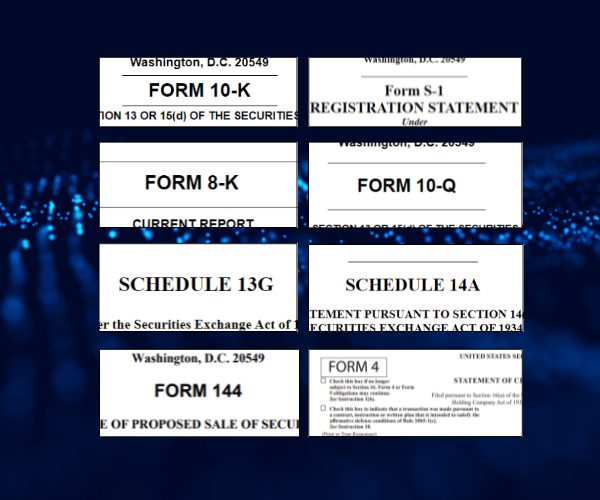
Before you can become an investor, it is important to conduct research on any possible companies that you are interested in and to identify whether or not they would serve as a good or bad investment. To determine this, you would need to look at companies’ financial statements, reports, and the major shareholders’ actions, which all can be publicly found in SEC filings.
Each year, the Securities and Exchange Commission (SEC) requires all publicly traded companies to submit in-depth filings regarding their current status, through the utilization of EDGAR, to help investors make informed decisions. The Electronic Data Gathering, Analysis, and Retrieval (EDGAR), is an electronic filing system designed by the SEC to improve efficiency and provide important information to potential investors in an accelerated fashion.
The reports filed with EDGAR are among some of the most important SEC filings and are vital in determining whether or not you should invest. Listed below are the top 15 most important SEC filings that will help you decide whether or not to invest:
1. Form 10-K- Annual Report
The best form to start with when you begin to analyze a company is the 10-K, which provides a brief overview of the company through includes potential risk factors as well as financial statements. The financial statement shows the company’s assets, liabilities, how the company is utilizing its money, and the company’s financial growth from the previous fiscal year. In addition, the 10-K will also contain a short discussion about the last year’s results which can answer many of your broad questions regarding their performance. The form also contains a section titled “Legal Proceedings” which reports any legal issues that they have recently faced. Although the 10-K will not provide you with an in-depth analysis of the company from an analyst’s point of view, it will provide a broad overview and allow you to dictate whether or not you should analyze the company more closely.
2. Form 10-Q – Quarterly Report
The Form 10-Q is a shorter version of the 10-K, meaning that instead of it covering the financial performance of the entire previous fiscal year, it instead focuses on the company’s performance in the previous quarter. The form is required to be filed within 40 days of the quarter’s end, which is a much shorter process than the 10-K. The 10-Q is important in addition to the quarterly earnings announcements because oftentimes they can provide additional formation. This quarterly form can help a potential investor focus on the company’s most recent performance and see if they are performing above or below expectations as well as provide them with new information about operating initiatives, new products, and the track record of their current operations.
3. Form DEF 14A – Proxy Statement
Form DEF 14A will provide information to the public about important actions that the company is planning on taking that will ultimately require shareholder approval. Such actions typically include the nomination of a new board member, deciding on a possible auditor, and voting on executive salaries. Although this document is often overlooked, it is very important when deciding whether or not the company is worthy of your investment. The form can show each executive’s salary and how bonuses are distributed; therefore, if the bonuses are tied to revenue or cash flow growth, it would serve as a good indicator of the company’s actions matching their overall goals.
4. Form 8-K – Current Report for Material Updates
Form 8-K provides a report on any possible material events that have come up and need to be shared with shareholders urgently. It is released when the company cannot wait until the quarterly report to share the information. Issues that would typically be discussed within the 8-K include the departure of an executive, a major acquisition, financing events, layoffs, accounting changes, and much more. The information contained within these reports can have a major impact on the stock price; therefore, they are always very important to read before an investment is placed.
5. Schedule 13D – Beneficial Ownership Report
Schedule 13D, also known as the beneficial owner report, is only filed when a shareholder buys more than 5% of the company’s outstanding shares with the intent to gain a vote in the company’s future. Based on the buyer’s intent, the stock can either be affected very positively or negatively. Within this form, the reasoning behind such a large acquisition is required, and based on the reasoning presented, insight could appear to a potential investor on whether or not the stock price will most likely increase or decrease.
6. Form 13G – Beneficial Ownership Report
Form 13G is required to be filed when someone purchases 5% of a company’s outstanding shares with no intention to have a vote in the company’s future. This type of purchase means that the buyer is accepting a role as a passive investor. Such a report is helpful because it typically serves as a good indicator of a company’s future success since it demonstrates a strong external belief in the business.
7. Form 13F – Quarterly Report
Form 13F is only required to be filed by large institutional investors who are managing more than $100 million. Such institutions are hedge funds and investment banks and the form requires them to disclose a detailed list of the company’s major holdings. Form 13F is required to be submitted quarterly; however, the institutions have up to 45 days after the quarter-end to submit the report. This 45-day period means that the company could have majorly altered its portfolio meaning that as a potential investor, it could be unwise to invest only in companies that major institutional investors included in their 13F. With that being said, the 13F is very helpful for investors because it could provide insight into how major institutions think and possibly even help you generate new investment ideas.
8. Form 4 – Statement of Changes in Beneficial Ownership
The SEC Form 4 is a report that discusses when shareholders, who own more than 10% of the company’s voting shares, or company insiders, such as directors, senior officers, and management, are buying or selling company stock. Form 4 shows transactions and serves as a statement of change in ownership. The report is useful for investors because when it is shown that an insider buys more shares, it appears as a green light to purchase stock; however, when insiders are selling stock, it is not always a bad sign. The selling of shares could be for several reasons including retirement or a pre-planned distribution program.
9. Form 144 – Notice of Proposed Sale of Securities
Form 144 is a notice, issued by company insiders, of their intent to sell restricted stock. The form only applies to insiders who are planning to unload 5,000 shares or $50,000 in stock on the open market. The form is beneficial to investors because it could be an indicator of the stock price dropping when a large quantity of shares hits the market.
10. Form ARS – Annual Report to Shareholders
The Form ARS is the only form on the list that is not necessarily required by the SEC; therefore, it most likely will not be available for the majority of the companies you will research. Form ARS is similar to the 10-K in the way it discusses the financial statements from the previous year, but it is different in the way that oftentimes they will contain tips on the company’s possible future. This information is helpful to potential investors because it allows them to see the company’s upcoming direction and determine whether or not they agree with it.
11. Form S-1 – Registration Statement for Initial Public Offerings
Form S-1 is a registration form that companies, who wish to be listed on the national exchange, are required to complete. Form S-1 is completed before a company can release its initial public offering (IPO). The form requires companies to share information regarding their current business model, proposed use of capital proceedings, competitors, possible dilution to shares and securities, as well as the utilized methodology to how they arrived at the offering price of a singular share. Form S-1 could be useful to potential investors because it would provide them with previously unknown information about a currently unlisted company on the national exchange. Learning about the company’s position and plans for the future could help a possible investor determine whether or not to buy shares of the company’s IPO to get in early.
12. Form S-3 – Registration Statement for Simplified Shelf Offerings
The Form S-3 is a simplified security registration statement that is filed by companies that have already completed all of their reporting, debt, and dividend requirements for the past 12 months. Such a form is typically utilized by companies when they wish to raise capital in the form of a secondary offering after the IPO has already occurred. Form S-3 requires less disclosure than many other registration statements, but it does release essential company and stock information which could be helpful to a potential investor.
13. Form 15-12G – Notice of Termination
The SEC Form 15-12G is a form that acts as a notice of termination for the registration of a class of securities. The filing of this form also can act as a symbol of the suspension of a company’s duty to file periodic reports. Oftentimes, the filing of Form 15-12G can be a predecessor to a company stating that it will be going out of business, which would be a bad sign to potential investors.
14. Form 1-A – Regulation A Offering Statement
Form 1-A is filed by companies who seek exemption from the registration requirements enforced by the SEC for public offerings that fall under the conditions of Regulation A. This means that the form waives all registration requirements for public offerings that are $75 million or less within a year. Companies that file Form 1-A are broken up into 2 tiers with tier 1 having public offerings capped at $20 million in securities and tier 2 having public offerings capped at $75 million. Since tier 2 contains larger companies, they are subject to following regular reporting requirements that tier 1 companies are not. Form 1-A could be beneficial to investors because the forms disclose significant information about the offered securities while simultaneously prohibiting fraud.
15. Form S-8 – Registration Statement for Employee Benefit Plans
Form S-8 is a filing that allows publicly traded companies to register securities for their employees as part of a benefit plan. An employee who could receive the issued stock includes anyone who serves the company such as partners, advisors, consultants, insurance agents, former employees, and even anyone related to deceased employees. For employees to receive the issued stock. a company will often implement an incentive plan, profit-sharing plan, bonus, or security-based compensation in order to give back. Form S-8 could be helpful to a potential investor because it shows that a company is rewarding its employees for their work. With employees now possessing a part of the company and sharing in the profits, the filing of Form S-8 could symbolize potential growth that would be beneficial to investors.
