
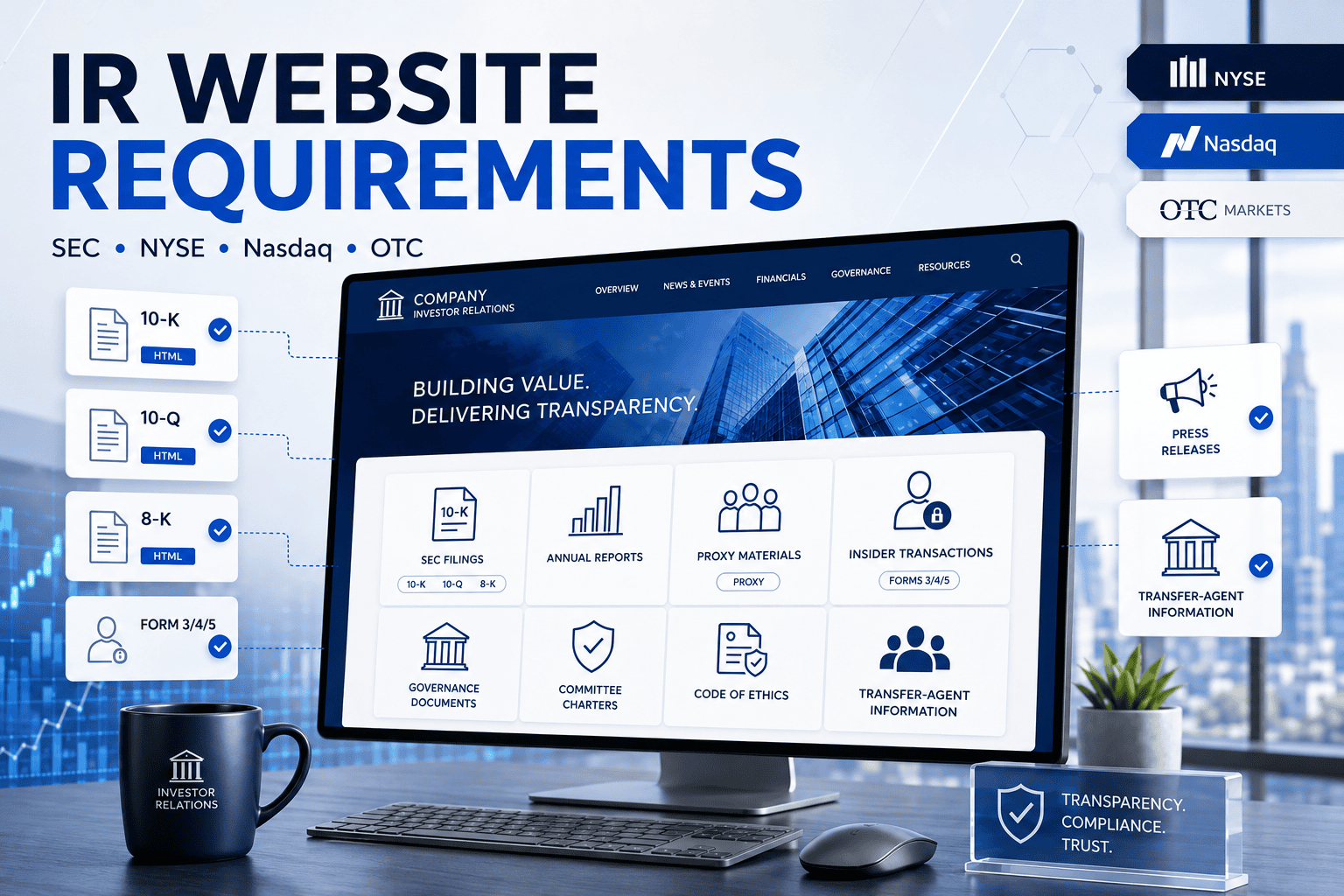
Building effective Investor Relations websites requires companies to distinguish legal obligations from recommended IR practices. A public company is not universally required to reproduce every SEC filing or piece of market information on its IR website. What it must publish depends on its SEC reporting status, exchange, chosen disclosure method, and any specialized rules that apply.
Among the principal items that may carry direct online-availability requirements are Forms 3, 4, and 5, certain proxy materials, annual reports, and governance documents for NYSE companies, and conflict-minerals disclosures when applicable. Other content, such as a complete SEC filing feed, transfer-agent details, press releases, stock quotes, and management biographies, is often recommended rather than legally required.
This guide explains the difference and provides a practical framework for building and maintaining a compliant, investor-friendly IR website.
This article addresses ordinary U.S. public operating companies. Foreign private issuers, investment companies, business development companies, banks, insurers, asset-backed issuers, and other specialized issuers may be subject to different requirements. This article is for general information and is not legal advice.
The most important distinction: required, optional, or recommended?
IR website content generally falls into four categories.
Direct website requirement
A rule specifically requires the company to make information available on its website or another qualifying internet site. Examples include:
- Forms 3, 4, and 5 for covered issuers that maintain a corporate website
- NYSE annual reports and specified governance documents
- Proxy materials when using SEC notice-and-access
- Conflict-minerals disclosure when applicable
Website as an optional compliance method
The company has an underlying disclosure or delivery obligation, but website posting is one permitted way to satisfy it. Examples include:
- Nasdaq annual report distribution
- SEC code-of-ethics availability
- Certain Nasdaq director-compensation disclosures
If a company chooses the website method, related timing, notice, retention, or cross-reference requirements may apply.
Public disclosure required, but not necessarily on the website
The company must disclose information publicly, but it can ordinarily use Form 8-K, a broadly distributed press release, or another Regulation FD-compliant method. Examples include:
- Material corporate developments;
- Earnings releases;
- Listing deficiencies;
- Dividends and stock splits; and
- Certain code waivers.
Maintaining these disclosures on the IR website is prudent, but the website is not always the required or sufficient distribution channel.
Recommended IR practice
The information is useful to investors but is not generally required as a standalone website item. Examples include:
- A stock quote or price chart;
- A board and management directory;
- Transfer-agent contact information;
- An investor FAQ, and
- A searchable archive of presentations and releases.
With those distinctions in mind, here is the conservative 11-item IR website framework.
IR website requirements at a glance
| IR website content | General status | When or where it applies |
| SEC filing feed | Recommended | Accelerated and large accelerated filers also have a related Form 10-K disclosure requirement |
| Forms 3, 4, and 5 | Direct website requirement | Applies to covered issuers that maintain a corporate website; reports must generally be posted by the next business day and remain accessible for at least 12 months |
| Annual reports | Depends on the market | Required on the website for NYSE companies; website posting is one permitted distribution method for Nasdaq companies; generally recommended for other SEC issuers |
| Proxy materials | Conditional online requirement | Required online when using SEC notice-and-access; the materials may be hosted on a qualifying third-party website |
| Corporate governance guidelines | Direct website requirement for NYSE domestic issuers | Generally recommended for Nasdaq and OTC companies |
| Committee charters | Required on the website for NYSE companies | Nasdaq requires written governance documents, but website publication is generally a prudent practice |
| Code of conduct and ethics | Depends on the applicable framework | Required on or through the website for NYSE companies; must be publicly available for Nasdaq companies; website posting is one permitted SEC method |
| Directors, officers, and committee memberships | Recommended | The underlying information is disclosed through SEC filings, but a standalone website page is generally not required |
| Material press releases | Recommended as a website archive | Prompt public disclosure may be required through Form 8-K, a press release, or another Regulation FD-compliant method |
| Transfer-agent information | Recommended | Certain OTC information must instead be maintained through applicable OTC Markets systems |
| Conflict-minerals disclosure | Direct website requirement when applicable | Applies to companies subject to Exchange Act Rule 13p-1 |
The detailed requirements and implementation considerations follow.
1. SEC filing feed covering Forms 10-K, 10-Q, 8-K, proxy statements, and Form SD
Current status: Recommended, with a related disclosure requirement for accelerated and large accelerated filers.
A public company should provide prompt, free access to material SEC filings. A comprehensive feed commonly includes Forms 10-K, 10-Q, and 8-K; proxy and information statements; Form SD; registration statements; Section 16 reports; and amendments.
An automated EDGAR feed is generally more dependable than manual uploads and reduces the risk of stale or incomplete filing information. However, the SEC does not impose a universal rule requiring every reporting company to reproduce every EDGAR filing on its website.
Accelerated and large accelerated filers must disclose in Form 10-K whether Forms 10-K, 10-Q, and 8-K, including amendments, are available free of charge on or through the company’s website as soon as reasonably practicable after filing or furnishing. If they are not available online, the company must explain why and indicate whether free electronic or paper copies are available on request.
That provision does not specifically cover every proxy statement or Form SD. Including those forms in a complete filing feed is a strong IR practice rather than a universal website mandate.
Reference: Regulation S-K Item 101(e)(4), 17 C.F.R. § 229.101(e)(4)
2. Forms 3, 4, and 5 must be posted promptly and retained for at least 12 months
Current status: Direct website requirement for covered issuers that maintain a corporate website.
Forms 3, 4, and 5 report securities ownership and transactions involving directors, officers, and certain beneficial owners subject to Section 16 of the Securities Exchange Act.
If an issuer maintains a corporate website, it must make each applicable Form 3, 4, or 5 accessible on that website:
- By the end of the business day following filing
- For at least 12 months
The issuer does not necessarily have to store a duplicate document on its own server. It may provide access through hyperlinks to reports filed on EDGAR if the links satisfy the rule’s timing and accessibility requirements.
References: Exchange Act Rule 16a-3(k), 17 C.F.R. § 240.16a-3(k) and SEC Section 16 compliance guidance
3. Annual reports
Current status: Required on the website for NYSE companies; website posting is one permitted distribution method for Nasdaq companies; generally recommended for other SEC issuers.
NYSE-listed companies
NYSE Listed Company Manual § 203.01 requires a company with listed voting or non-voting common securities to make its annual report available on its website. The annual report will ordinarily be the company’s Form 10-K, Form 20-F, or Form 40-F.
The company must generally post the report simultaneously with its SEC filing and issue a press release stating that the report has been filed, is available through the company’s website, and can be found at the specified website address.
Reference: NYSE Listed Company Manual § 203.01; see the SEC-approved rule text.
Nasdaq-listed companies
Nasdaq Rule 5250(d)(1) requires a listed company to make an annual report containing audited financial statements available to shareholders within a reasonable period after filing it with the SEC. Depending on the circumstances, a company may satisfy the requirement by mailing the report, using SEC notice-and-access, or posting the report on or through its website.
A company relying on the website option must include a prominent undertaking to provide a free hard copy on request and simultaneously issue a press release stating that the report has been filed, is available through the company’s website, and may be obtained in hard copy free of charge.
Website posting is therefore a permitted compliance method, not the only method available to Nasdaq companies.
Reference: Nasdaq Rule 5250(d)(1)
Other SEC-reporting companies
SEC proxy rules generally require an annual report to accompany or precede a proxy statement for an annual meeting at which directors will be elected. This is principally a shareholder-delivery obligation rather than a blanket requirement to maintain the report on the corporate website.
Reference: Exchange Act Rule 14a-3, 17 C.F.R. § 240.14a-3
4. Proxy materials and shareholder meeting information
Current status: Internet posting is required when using SEC notice-and-access, but the required site does not have to be the company’s main IR website.
When a company uses notice-and-access, the proxy materials identified in the Notice of Internet Availability must be publicly accessible online, free of charge. Depending on the solicitation, these materials may include the proxy statement, proxy card, annual report, meeting notice, voting instructions, and additional soliciting materials.
The materials must generally be available by the time the notice is sent and remain available through the conclusion of the meeting. Additional soliciting materials must be posted no later than the day they are first sent to shareholders or made public. The site cannot simply be EDGAR and must be operated in a way that does not compromise visitor anonymity.
A qualifying third-party proxy website may satisfy the rule. The corporate IR website should nevertheless link prominently to it.
Reference: Exchange Act Rule 14a-16(b), (j), and (k), 17 C.F.R. § 240.14a-16, and the SEC notice-and-access adopting release
5. Corporate governance guidelines
Current status: Direct website requirement for NYSE domestic issuers; generally a best practice for Nasdaq and OTC companies.
NYSE-listed domestic companies must adopt and disclose corporate governance guidelines addressing matters such as director qualifications and responsibilities, director access to management and independent advisers, director compensation, orientation and continuing education, management succession, and annual board performance evaluations.
A current copy must be available on or through the company’s website.
Reference: NYSE Listed Company Manual § 303A.09; see the SEC approval of the NYSE corporate governance standards.
Nasdaq does not impose an equivalent general rule requiring every listed company to adopt and publish standalone corporate governance guidelines. Nasdaq companies commonly publish them as a clear summary of board practices.
6. Audit, compensation, and nominating or governance committee charters
Current status: Website availability is required for NYSE companies. Nasdaq requires written charters or resolutions, while website publication is generally a prudent disclosure practice.
NYSE-listed companies
NYSE domestic issuers generally must make current copies of their audit, compensation, and nominating or corporate governance committee charters available on or through their websites under § 303A.04, §303A.05, and §303A.07.
Reference: SEC approval of NYSE § 303A
Nasdaq-listed companies
Nasdaq Rule 5605 requires appropriate written governance documents, including formal written audit and compensation committee charters and a nominating committee charter or board resolution addressing the nomination process. Its requirements primarily concern adoption, content, committee responsibilities, and certification rather than the same universal website-publication framework imposed by NYSE.
Reference: Nasdaq Rule 5605
SEC proxy disclosure
Regulation S-K Item 407 requires proxy-statement disclosure about committee charters. Under its instructions, making a current charter available on the company’s website and identifying its location in the proxy statement may avoid the need to attach the charter to the proxy statement periodically.
Reference: Regulation S-K Item 407 and related instructions, 17 C.F.R. § 229.407
7. Code of conduct and ethics
Current status: Required on or through the website for NYSE companies; must be publicly available for Nasdaq companies; website posting is one permitted SEC method.
NYSE-listed companies
NYSE-listed companies must adopt and disclose a code of business conduct and ethics applicable to directors, officers, and employees. The code must be available on or through the company’s website and address subjects such as conflicts of interest, corporate opportunities, confidentiality, fair dealing, company assets, legal compliance, and reporting illegal or unethical behavior.
Reference: NYSE Listed Company Manual § 303A.10; see the SEC-approved NYSE standards.
Nasdaq-listed companies
Nasdaq Rule 5610 requires every listed company to adopt a code of conduct applicable to directors, officers, and employees and make it publicly available. Posting it in the corporate governance section of the IR website is the usual compliance method.
Reference: Nasdaq Rule 5610 and IM-5610
SEC code-of-ethics rule
Regulation S-K Item 406 focuses on a code of ethics covering the principal executive officer, principal financial officer, principal accounting officer or controller, and persons performing similar functions.
A company may satisfy the SEC availability requirement by filing the code as an exhibit to its annual report, posting it on its website and identifying the website in the annual report, or undertaking to provide a free copy on request. Website posting is one SEC option, not a universal mandate.
Reference: Regulation S-K Item 406(c), 17 C.F.R. § 229.406(c)
Amendments and waivers
A material amendment to or waiver of a covered provision may trigger disclosure under Form 8-K Item 5.05. A reporting company may use website disclosure instead of Form 8-K only if it previously disclosed its website address and its intention to use that website for such disclosures.
The information generally must be posted within four business days, remain online for at least 12 months, and be retained for at least five years. NYSE and Nasdaq also impose requirements concerning approval and public disclosure of waivers granted to directors or executive officers.
References: Form 8-K, Item 5.05, Regulation S-K Item 406(d), NYSE Listed Company Manual § 303A.10, and Nasdaq Rule 5610 and IM-5610
8. Current directors, officers, and committee memberships
Current status: Recommended as a standalone website section; the underlying information is required in SEC filings and governed by exchange standards.
SEC rules require substantial information about directors and executive officers in applicable registration statements, annual reports, and proxy materials. That information may include names and positions, ages and business experience, other public-company directorships, family relationships, specified legal proceedings, director independence, committee memberships, audit committee financial experts, and other governance arrangements.
The SEC generally does not require a separate directors-and-officers page on the corporate website. Publishing one is nevertheless a strong IR practice because it lets investors identify board leadership, committee assignments, director independence, executive responsibilities, and recent changes quickly.
References: Regulation S-K Item 401, Regulation S-K Item 407, Nasdaq Rule 5605, and NYSE Listed Company Manual §§ 303A.01–303A.07
9. Current material press releases
Current status: Prompt public disclosure may be required, but maintaining releases on the website is generally a best practice rather than the exclusive required disclosure channel.
NYSE and Nasdaq companies must promptly disclose material information that could reasonably affect the market for their securities or influence investment decisions. Examples may include financial results, earnings guidance, mergers, material contracts, financing transactions, changes in directors or executive officers, dividends, stock splits, significant litigation, cybersecurity incidents, auditor changes, regulatory actions, and listing deficiencies.
Nasdaq Rule 5250(b)(1) requires prompt disclosure through a Regulation FD-compliant method, and NYSE rules impose comparable material-news requirements. Depending on the circumstances, a company may use Form 8-K, a broadly distributed press release, a properly announced investor call or webcast, or another method designed to provide broad, non-exclusionary distribution.
A website-only disclosure may satisfy Regulation FD only when the website is a recognized channel of distribution and the information is disseminated broadly enough for the market to receive it. Companies should not assume that placing material information on a lightly visited webpage, without more, is adequate public disclosure.
References: Nasdaq Rule 5250(b)(1), NYSE material-news guidance, SEC Regulation FD guidance, and SEC Guidance on the Use of Company Websites
10. Transfer-agent contact information
Current status: Recommended on SEC, NYSE, and Nasdaq issuer websites; certain OTC profile and share information is required through OTC Markets systems.
A transfer agent assists registered shareholders with ownership records, account maintenance, address changes, lost or replacement certificates, share transfers, dividend payments, and direct-registration questions.
There is no broad SEC, NYSE, or Nasdaq rule requiring every operating company to maintain a standalone transfer-agent page. Publishing the transfer agent’s legal name, mailing address, telephone number, website, online account link, and areas of responsibility remains a basic investor-service practice.
OTC companies
OTCQX, OTCQB, and OTCID companies may have separate obligations to maintain current company-profile, transfer-agent, shares-outstanding, authorized-share, public-float, and Transfer Agent Verified Shares information. These requirements generally apply to the company’s profile and disclosures on OTCMarkets.com, not necessarily its corporate website.
References: OTCQX U.S. company requirements, OTCQB Rules, and OTCID requirements
11. Conflict-minerals disclosure, if applicable
Current status: Direct website requirement for companies subject to Exchange Act Rule 13p-1.
Rule 13p-1 applies when conflict minerals are necessary to the functionality or production of a product manufactured or contracted to be manufactured by the reporting company. Covered minerals include gold, tin, tantalum, and tungsten.
Depending on the company’s reasonable country-of-origin inquiry and any required due diligence, it may need to file Form SD and a Conflict Minerals Report. The applicable disclosure must be publicly available on the company’s website. When a Conflict Minerals Report is required, it must also be available through the website, and Form SD must identify the applicable internet address.
This requirement is product- and supply-chain-specific and does not apply to every reporting company.
References: Exchange Act Rule 13p-1, 17 C.F.R. § 240.13p-1 and the SEC Conflict Minerals Disclosure Compliance Guide
12. Important obligations that are not necessarily IR website mandates
Several public-company obligations are easy to mistake for requirements to publish information permanently on the issuer’s own website.
Material disclosure under Regulation FD
Regulation FD requires broad, non-exclusionary disclosure following certain intentional or unintentional selective disclosures. It does not automatically require publication on the corporate website. Form 8-K, a widely distributed release, a properly announced webcast, or another compliant channel may satisfy the requirement. A company website qualifies only under the circumstances described in the SEC’s website guidance.
Corporate-action notifications
NYSE and Nasdaq require advance notification and public disclosure of certain dividends, distributions, record dates, stock splits, reverse stock splits, redemptions, additional share issuances, and other corporate actions. These obligations often involve notice to the exchange and a Regulation FD-compliant public announcement; they do not necessarily require permanent retention on the IR website.
OTC Markets disclosure
OTCQX, OTCQB, and OTCID requirements often call for information to be published through EDGAR, OTC Markets’ Disclosure & News Service, OTCIQ, SEDAR+, or another approved channel. Publication on OTCMarkets.com is not the same as an issuer-website mandate.
State annual reports
State annual or periodic reports are generally filed with the Secretary of State or a similar authority. They are not the same as shareholder annual reports or Form 10-K and ordinarily do not have to be reproduced on the IR website.
13. Outdated website requirements to avoid
Older compliance materials may describe requirements that no longer apply.
Standalone XBRL website posting
Operating companies were previously required to post Interactive Data Files on their corporate websites. The SEC eliminated that separate requirement through its 2018 Inline XBRL amendments. Companies must continue filing applicable Inline XBRL data through EDGAR, but they do not have to maintain separate XBRL instance documents on their own websites solely because of the former rule.
Companies may still provide XBRL downloads or structured-data access as an investor service.
References: SEC Inline XBRL adopting release and SEC operating-company compliance guide
Physical distribution of NYSE annual reports
Older NYSE materials may emphasize physical delivery as the principal exchange requirement. NYSE amended § 203.01 in 2006 to establish its current website-based availability framework. SEC proxy-delivery requirements and Nasdaq’s free-hard-copy procedure may still apply, so the NYSE change did not eliminate all shareholder-delivery obligations.
Reference: SEC-approved NYSE § 203.01 amendments
NYSE print-on-request requirement for governance documents
Older summaries of NYSE § 303A may state that companies must provide printed committee charters, governance guidelines, and codes of conduct upon request. NYSE later removed that separate requirement. Current compliance should focus on maintaining the required documents on or through the company’s website.
This should not be confused with current hard-copy obligations such as the Nasdaq annual-report procedure when a company relies on website posting under Rule 5250(d)(1).
Reference: SEC approval of NYSE governance-rule amendments
14. Are stock quotes and charts required?
Generally, no. SEC, NYSE, and Nasdaq rules do not ordinarily require a public operating company’s website to display its current share price, historical price chart, trading volume, market capitalization, analyst coverage, shareholder-return calculator, dividend history, or CUSIP number.
These features can make an IR website more useful, but they are usually investor-relations tools rather than legal requirements. If a company displays market data, it should clearly identify the source, whether the quote is real-time or delayed, the applicable market, currency, “as of” date and time, and any important adjustment or calculation methodology.
Stale or inaccurate market information can confuse investors and create risk under the federal antifraud rules.
Reference: Exchange Act Rule 10b-5, 17 C.F.R. § 240.10b-5
15. A practical IR website checklist for 2026
A compliance-oriented U.S. public-company IR website should provide:
- A reliable, current SEC filing feed
- Dedicated access to Forms 3, 4, and 5, with required posting and retention controls
- Current and historical annual reports
- Proxy materials or a prominent link to the proxy website
- Shareholder meeting information and access instructions
- Corporate governance guidelines where required or adopted
- Current audit, compensation, and nominating or governance committee charters
- A current code of conduct and ethics
- Current directors, officers, and committee memberships
- A dated material-news and press-release archive
- Current transfer-agent contact information
- Applicable conflict-minerals disclosure and reports
- Required non-GAAP reconciliations with relevant earnings materials
- Clear separation between current and archived information
- Monitoring for broken EDGAR, proxy, and document links
The exact legal minimum will depend on the company’s filer status, exchange, industry, disclosure methods, and circumstances.
16. The bottom line
A public company does not have to place every EDGAR filing, XBRL file, or item of market information on its corporate website. Its most significant online obligations may include Section 16 reports, notice-and-access proxy materials, NYSE annual reports and governance documents, a publicly available Nasdaq code of conduct, Nasdaq annual-report access under a permitted distribution method, and conflict-minerals disclosure when Rule 13p-1 applies.
The legal minimum, however, should not be the only design standard. A dependable IR website gives investors one place to find current filings, annual reports, proxy materials, insider reports, governance documents, news, and company information. The essential step is to classify each feature correctly as a direct website requirement, optional website compliance method, broader public-disclosure obligation, or recommended IR practice.
Maintaining these disclosures manually can create gaps, outdated links, and inconsistent archives. SEC Filing Data provides real-time EDGAR data, automated filing feeds, Section 16 data, IR website tools, and custom filing integrations.
This article is for general informational purposes only and does not constitute legal advice. Companies should consult securities counsel regarding the requirements applicable to their SEC filer status, exchange, industry, and circumstances
