
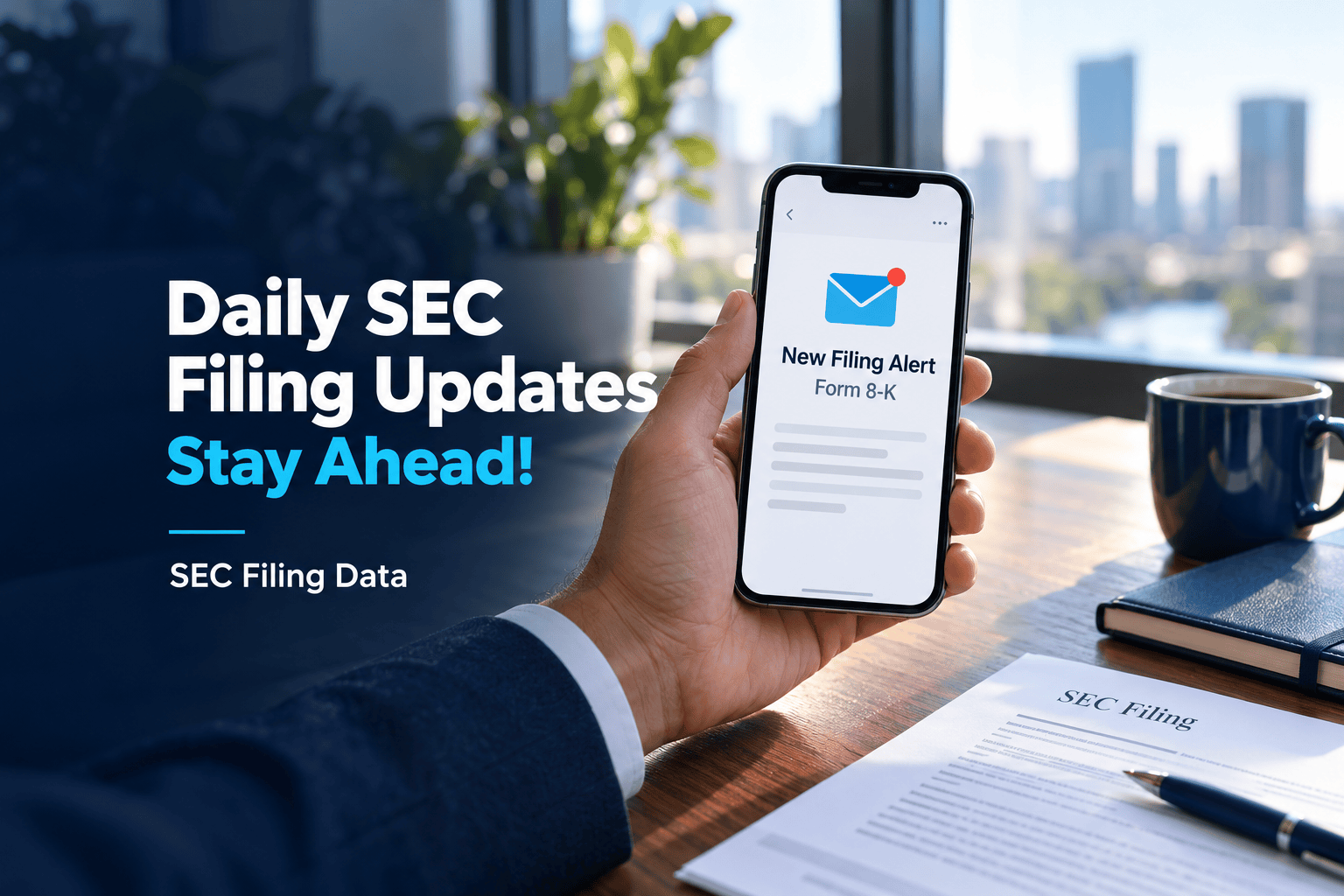
A company’s next important disclosure may arrive between earnings dates, annual meetings, or scheduled research reviews. SEC Filing Updates help you notice when new information is available, so you can decide whether it belongs in your research. The value is not that every filing predicts what happens next. It is that a timely alert can point you toward a disclosure worth reading.
What is an SEC filing?
An SEC filing is a document that a company, fund, officer, director, or other filer submits to the U.S. Securities and Exchange Commission. These documents can include financial reports, announcements of significant events, ownership reports, proxy materials, and registration statements. Public filings are available through the SEC’s EDGAR search tools.
The phrase “SEC filings updates” can refer to new documents, amendments, or periodic reports appearing in EDGAR. Which ones matter depends on what you follow and why. An investor researching one company may care about its quarterly results; a competitor’s strategy team may monitor major agreements or leadership changes across an industry.
Why follow daily SEC Filing Updates?
If you follow a biotechnology company for partnership and pipeline updates, an 8-K reporting entry into a material definitive agreement, such as a licensing agreement, may be more relevant to that research question than an unrelated Form 4. That does not make the Form 4 unimportant; relevance depends on what you are trying to learn.
A filing can add detail missing from a headline or earnings summary. A Form 8-K may report specified current events, including leadership departures or material agreements. Most items are generally due within four business days, subject to exceptions. An alert can point readers to a disclosure for review.
Annual and quarterly reports provide another kind of update. A 10-K covers the company, risks, and annual financial reporting; a 10-Q updates the first three fiscal quarters. Comparing reports can show how disclosures change over time, but a filing alone does not tell you whether a company is a good investment.
When a filing appears, check the company or reporting person, form, filing date, and any reporting or event period. These details distinguish a newly reported event from a report about an earlier period. Look for amendment marks such as “/A” and read amendments alongside the original. The filing index may also list exhibits with important detail. An alert is a pointer; consult the filed document when a fact matters.
Not every new document needs urgent review. One reader may prioritize a followed company’s 8-Ks and review annual reports on a schedule; an analyst comparing peers may watch quarterly reports and industry-specific forms. Choose alerts for a clear research question, then adjust the list if it creates noise or misses useful updates.
Timely notices also support work beyond stock research. Analysts can compare how companies discuss demand, costs, or risks. Business-development teams may follow competitor acquisitions or financing; legal and compliance teams may monitor filings about companies, officers, or ownership changes.
Without a routine, a relevant document may surface only during a later review, leaving a company brief based on an older filing or a proxy proposal undiscovered. Alerts reduce manual checking, but do not replace reading the document in context.
Filing types worth knowing
Different forms answer different questions. These common examples can help you choose what to monitor:
- Form 8-K: A current report covering specified events, such as a major agreement, executive change, or bankruptcy-related event. Read the item and any exhibits; the form’s title alone may not explain the full development.
- Form 10-K: An annual report with information about the company, its risks, management’s discussion, and financial statements. Investors and analysts often use it for a broad review of the business and changes since the prior year.
- Form 10-Q: A quarterly report for the first three fiscal quarters. It can help readers follow financial performance and updates to the company’s discussion between annual reports.
- Form 4: A statement of changes in beneficial ownership filed by certain insiders, including officers, directors, and some significant owners. A reported transaction needs context: it may involve different transaction types and does not automatically reveal a person’s reason.
- DEF 14A: A definitive proxy statement that gives shareholders information about matters for a vote, such as director elections, executive compensation, or other proposals. It may be useful ahead of a shareholder meeting.
- Schedule 13D or 13G: Beneficial ownership reports for certain holders of more than five percent of a covered class of equity securities. The schedules differ by filer eligibility and circumstances; a new filing can prompt questions about ownership or intentions, but it is not a forecast of what the company or stock will do.
- Form S-1: A registration statement commonly used when a company registers securities for a public offering. Updates may be relevant to readers researching a potential offering, but filing an S-1 does not ensure that an offering will be completed.
- Form 6-K: A report furnished by a foreign private issuer for information it makes public or files in its home jurisdiction, subject to SEC rules. Readers following non-U.S. issuers may want to include it in their monitoring.
What can happen when you miss a filing?
Suppose a researcher is preparing a sector update and learns later that a tracked company filed an 8-K describing a change to a major commercial agreement. A delayed review could leave the research note relying on the prior understanding of that relationship. Or an investor who follows insider transactions may not see a Form 4 until a routine account review, making it harder to place the transaction alongside other company disclosures.
These examples illustrate the cost of stale information, not a guaranteed financial outcome. A filing can be routine, incomplete, or difficult to interpret without related documents. Its publication alone does not prove why a stock moved or what will happen next. Treat an alert as a prompt to examine the source, dates, exhibits, and surrounding disclosures—not as a buy or sell instruction.
How SEC Filing Data’s free alerts work
The alert page offers company, individual or insider, fund, form-type, and filing-insight choices. Follow one company or track one form across filers; the page also describes criteria based on filers, forms, keywords, or filing insights.
Create a free account with an email address, password, and requested account information. Set an alert from a category or a filing table’s action control, then view or edit saved alerts on the Alerts page. The service says matching filings prompt email notifications linking to filing details, where you can review the source.
The service describes alerts as real-time or instant but gives no delivery-time guarantee, and email delivery can vary. For broader monitoring, SEC Filing Data’s recent SEC filings page displays a filing stream alongside selected alerts.
A practical filing-alert workflow
- Choose what to monitor: Select a company, individual, fund, form type, or filing insight. You can choose one relevant target; you do not need to select both a company and a form.
- Create the alert: Use the relevant alert category or a filing table’s action control.
- Receive an email notification: The service says it emails you when a matching filing appears; delivery time is not guaranteed.
- Review the filing: Check the filer, form, date, amendments, and filing details against your research question.
- Record your findings: Note what matters to your research. Recording findings is your step, not an SEC Filing Data feature.
Set a focused monitoring routine
Choose companies, people, or forms tied to your work. Keep the list manageable; when an alert arrives, confirm the filer and form, read the document, and compare earlier disclosures if relevant. Note what changed and what remains unknown.
SEC Filing Updates make disclosures easier to notice and reduce repetitive checking. Use a clear process to decide what merits attention and verify the source before concluding.
A focused alert list can help reduce routine manual EDGAR checking and make it easier to notice filings that match your criteria. Explore free SEC filing alerts to choose the companies, forms, or filers you want to follow.
