
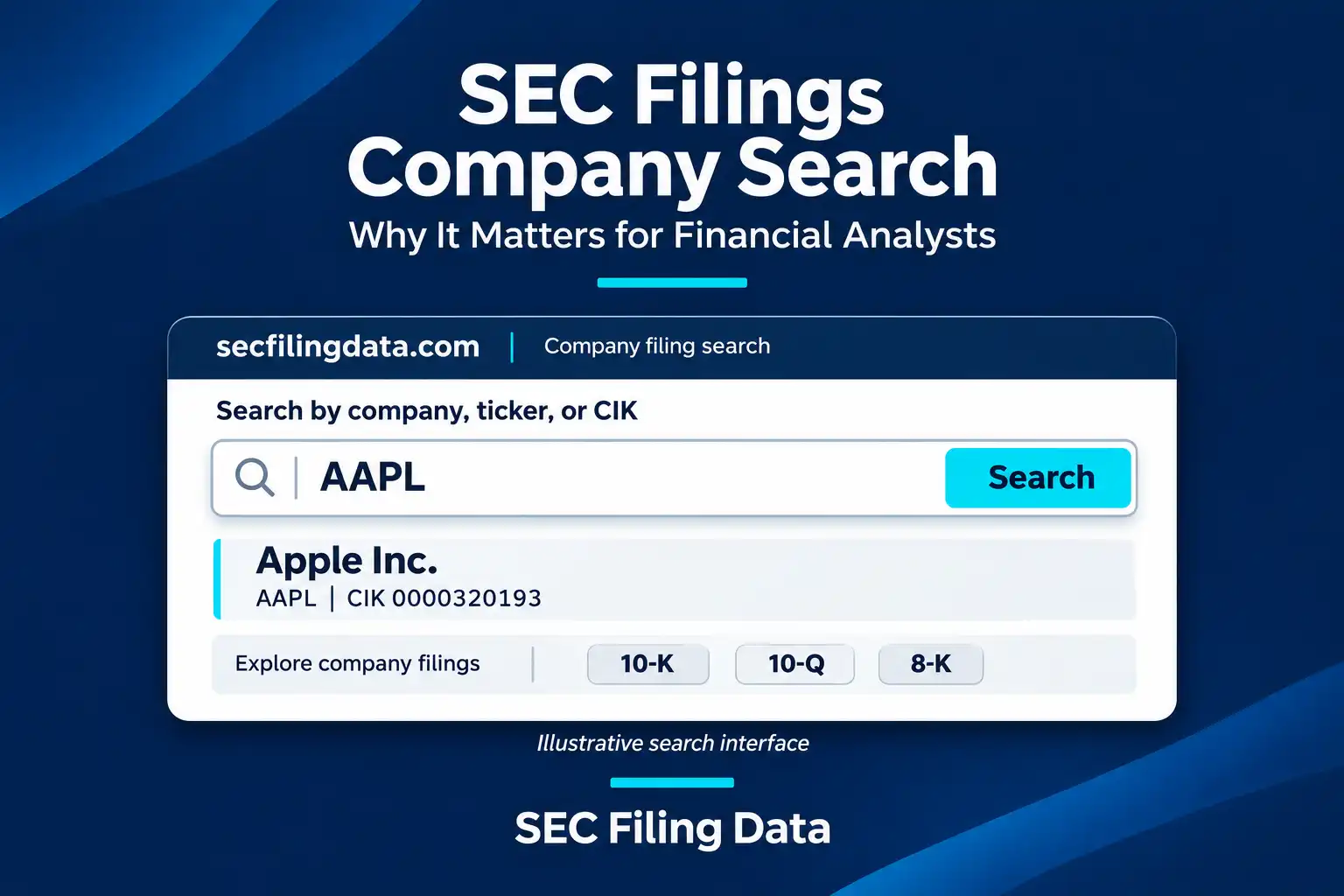
The SEC filings company search workflow gives analysts a practical starting point: identify the right filer, find relevant disclosures, and track them over time. A company name is often where research begins, but it may not identify the right disclosure. A ticker can be ambiguous or change; a familiar brand may file under a different legal name, and one corporate group can include multiple filers.
The value is practical: less time sorting unrelated results and a clearer trail from a research conclusion back to the underlying filing. A SEC filing search can be the first step in that workflow, provided the analyst confirms the filer and reads the source document before concluding.
Why search by company first?
A company-level search narrows the universe to filings associated with one filer. That matters when the research question is issuer-specific: Has the company changed its risk disclosure? What did management say about cash flow this quarter? Did a current report describe a new agreement or leadership change? Searching company-first makes it easier to line up relevant filings and compare them across periods.
It also helps prevent a common research error: treating a search result as if it already answers the question. Filing metadata can tell you who filed, what form was submitted, and when it was filed. It does not, by itself, establish what the filing says or what the disclosure means for a company’s outlook.
Confirm the filer before reviewing documents
Start with the company’s legal name, ticker, or Central Index Key (CIK). A CIK is an identifier the SEC assigns to a filer; it is generally a more precise way to distinguish similarly named entities than a brand name alone. A ticker is convenient for discovery, but the search result still needs to be checked against the filer’s name and other available company details.
For example, the SEC’s company page identifies Apple Inc. as CIK 0000320193. If an analyst is building an Apple filing history, confirming that name and identifier makes the search reproducible and helps avoid mixing in another filer. A CIK can narrow a search to the exact company or person.
The same check matters for corporate groups. A parent, subsidiary, fund, or individual associated with a company may file under a separate identity. When a search returns several plausible matches, confirm which entity submitted the disclosure and whether that entity is the one relevant to the research question.
Choose forms that match the question
Once the issuer is confirmed, narrow the filing history by form and period. Form type is a useful first screen because different filings serve different purposes. The SEC’s guide to using EDGAR to research investments describes common forms this way:
| Research question | Start with | What to check |
|---|---|---|
| How did the company perform this year? | Form 10-K | Annual financial statements, management’s discussion, and risk factors |
| What changed this quarter? | Form 10-Q | Quarterly statements, management’s discussion, and changes since the prior report |
| What significant event did the company report? | Form 8-K | Relevant item, event date, and any exhibits |
| What proposals are shareholders being asked to vote on? | DEF 14A | Proposals, voting matters, and related disclosures |
| What insider ownership information or changes were reported? | Forms 3, 4, and 5 | Filing purpose, transaction codes, and footnotes |
These forms are starting points, not substitutes for reading. A Form 8-K can include different items and exhibits; an analyst interested in an agreement may need to open the attached exhibit. Forms 3, 4, and 5 cover insider ownership reporting, but a form’s presence alone does not establish a transaction’s significance or the insider’s reason.
A repeatable company-first workflow
A useful workflow connects each search decision to a research question:
- Write down what you need to learn. For a quarterly update, a 10-Q may be the best starting point. For a major event between reports, look for a relevant 8-K. For a multi-year risk review, start with several 10-Ks.
- Resolve the issuer. Search a legal name, ticker, or CIK, then verify the selected filer. Record the identifier you used so another analyst can reproduce the search.
- Narrow the filing list. Select the form type and period that fit the question. Check the filing date separately from the reporting period or event date, and notice whether the form is an amendment, such as a 10-K/A.
- Open the filing and its relevant exhibits. Read the specific sections that bear on the question. For financial statements or narrative disclosures, use the filing itself rather than relying on a search-result row or a third-party summary.
- Compare like with like. Compare the same form or disclosure across periods. Record what changed, what stayed consistent, and which filing section supports the observation.
- Keep a source trail. Capture the filer, CIK, form, filing date, reporting period or event, and source link with your notes.
The discipline is simple: search identifies the document; the filing supplies the evidence. This separation makes research easier to audit and reduces the risk of reading too much into a filing label or headline.
Examples of the workflow in practice
Hypothetical operating review: An analyst wants to understand whether a retailer’s inventory pressure is easing. They confirm the retailer’s filer, open its latest 10-Q, and review the financial statements and management discussion for inventory levels, cash flow, and explanations of changes. They then compare the same measures and discussion with prior quarters and the latest 10-K. The search locates the filings; the analyst’s comparison tests the question.
Hypothetical event review: An analyst following a software company sees a news report about a major customer agreement. They search that company’s filings for a recent 8-K, confirm the filer and date, and read the relevant item and any attached agreement. They then compare the disclosed terms with the company’s existing risk and revenue discussion. The filing may add facts, but it does not automatically prove how much revenue the agreement will generate.
Hypothetical governance review: An analyst studying executive compensation selects the company’s DEF 14A, then compares the compensation discussion and voting matters with prior proxy statements. If a Form 4 appears in the same period, the analyst treats it as a separate ownership disclosure and checks its transaction codes and footnotes before interpreting it.
Follow a company over time and scan what is new
A company’s filings form a timeline, not a single document. Comparing annual and quarterly reports can reveal changes in risk language, liquidity, segment discussion, legal proceedings, or management’s explanations. But changes in wording or numbers need context: fiscal periods may differ, accounting presentation may change, and an amended filing can revise an earlier disclosure.
Company-level search supports depth on one issuer. A recent-filings list supports breadth when the analyst is scanning the market for new submissions and then deciding which companies merit a closer review. SEC Filing Data also publishes a recent-filings list that can help surface a new form or filer, after which company-level research provides the context. A new filing is a prompt to investigate, not evidence by itself of a material change in value.
Where SEC Filing Data fits
SEC Filing Data is a source for discovery and a data provider. Its company search accepts a company, ticker, or CIK. The published How to Find and Search Within SEC Filings article explains how to select a filer, narrow results by form type, open a filing, and optionally download a PDF. As the article notes, using the search tool may require an account. When the document matters, verify its contents against the source filing linked from SEC.gov.
For a programmatic workflow, SEC Filing Data’s Query API documentation supports metadata queries by company name, ticker, CIK, and form type, with pagination fields. It returns filing metadata and available SEC source links. That is useful for building a repeatable list of records, but it is not a search of the filing’s words: the API home page marks full-text search as coming soon.
Before building a repeatable filing list, match the company name or ticker to the intended filer and confirm its CIK; SEC Filing Data’s SEC company lookup guide shows this identity check as the first step.
The SEC Query API documentation describes the supported request behavior. Neither metadata search nor a filing list should be mistaken for an interpretation of the filing.
Make the search part of the research record
The strongest company search workflow is repeatable: identify the filer, select filings that fit the question, review original documents, compare the right periods, and preserve the source trail. That process gives analysts a structured way to follow company developments without assuming that every filing is equally relevant or that a disclosure predicts an investment outcome.
