
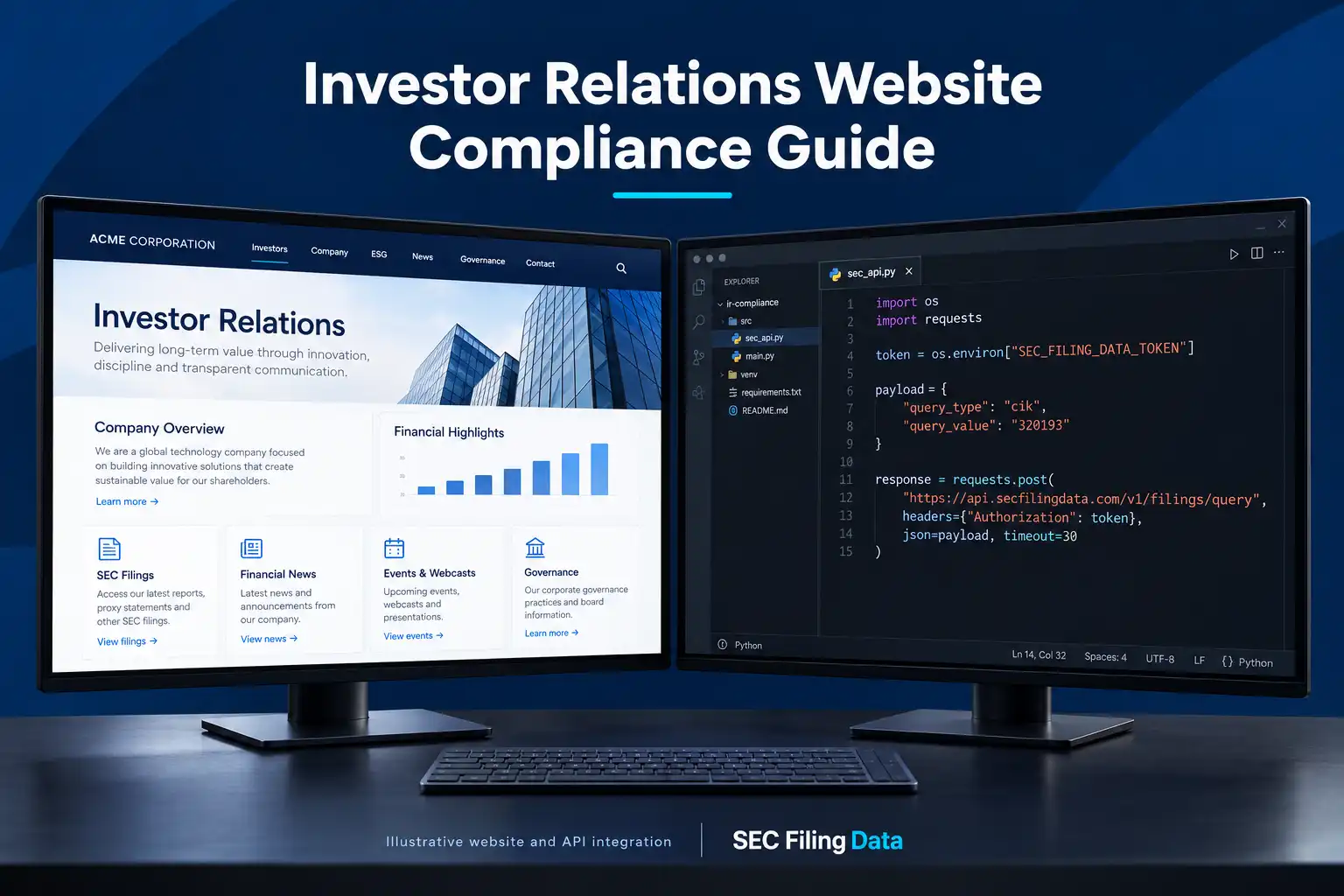
An investor relations website helps shareholders, analysts, and prospective investors find filings, financial news, governance materials, presentations, and events. It improves access but does not automatically satisfy an SEC filing or delivery obligation; duties depend on the applicable rule and issuer’s facts.
Quick Compliance Snapshot
Use this table as an orientation aid; the exact duties depend on the issuer and facts.
| Check | Quick question |
|---|---|
| Filing or delivery | Have required SEC filings and any applicable delivery or website-posting requirements been met using a permitted method? |
| Regulation FD | If Regulation FD applies, is disclosure broad, non-exclusive, and timely? |
| Accuracy | Do figures, dates, labels, and outlook match approved source materials? |
| Approved channels | Are releases, webcasts, and social posts coordinated with the issuer’s disclosure process? |
| Archive context | Are older materials dated and clearly distinguished from current information? |
| Ownership | Are a content owner, approver as applicable, and publication record identified? |
Know what the website does-and does not do
Covered issuers file reports such as Forms 10-K, 10-Q, and 8-K through EDGAR, each with its own deadlines. A website copy can help investors find a filing, but website publication alone does not replace a required SEC filing. Separate posting or electronic-delivery rules may apply depending on the issuer and method.
Use the IR site as a directory to authoritative materials. Date releases and presentations, identify their period, link related filings, and label materials as filed, furnished, supplemental, or historical. Make clear whether headlines and forecasts are current.
Online posting duties vary: some rules require or permit a website as a notice or availability method, while other useful material is optional. A separate overview of IR website requirements explains the distinctions. Counsel should confirm the rules that apply to the issuer.
Regulation FD: plan the public distribution
Regulation FD covers certain selective disclosures of material nonpublic information to securities-market professionals and shareholders likely to trade. Intentional disclosures require simultaneous public disclosure; unintentional disclosures must be made promptly. An issuer may use a Form 8-K or another method reasonably designed for broad, non-exclusionary distribution. SEC Regulation FD interpretations and website guidance explain that a website may qualify in some circumstances; public access alone is not enough.
The SEC considers whether the site is a recognized channel, whether information is accessible and disseminated, and whether it can meet timing requirements. Assess disclosure history and audience behavior; a hard-to-find page may not reach investors broadly. Many issuers coordinate the IR post with a release or Form 8-K and keep materials online as a stable reference.
For an earnings webcast, publish its date, time, subject, access details, and presentation location. SEC staff recommends adequate advance notice; for a regular quarterly call, for example, several days. State where and how long a replay or transcript will be available. Keep the release, slides, remarks, replay, and transcript consistent. A changed result or guidance needs a disclosure decision, not a silent slide replacement.
Keep published materials accurate and aligned
Treat filings, earnings releases, web pages, PDFs, webcast remarks, email alerts, and social posts as one disclosure set. Compare key figures, dates, definitions, outlook, and reconciliations with the approved source; record the approved version and publication time.
Non-GAAP measures need care. Regulation G generally requires the comparable GAAP measure and reconciliation when a company publicly discloses a material non-GAAP measure, including on a website or webcast. For covered filings and furnished earnings releases, Regulation S-K Item 10(e) addresses equal-or-greater prominence for GAAP. Inconsistent calculations or labels may mislead despite a reconciliation.
Identify forward-looking statements, guidance, targets, and projections, and tailor cautionary language to their actual risks and assumptions. A statutory safe harbor applies only when its conditions are met, and no exclusion applies. Cautionary text does not excuse a false statement or omitted context. Counsel should review the wording, placement, and continued prominence of old forecasts.
Date materials and separate current content from archives. The SEC has explained that leaving older materials online does not necessarily reissue them; context still matters. Label archives with their date and period, and link later updates. Correct inaccurate content promptly and visibly, logging what changed and why. Do not overwrite a document in a way that hides a needed correction.
Social media and mobile access
Social media can support investor communications, but a post is not automatically an adequate Regulation FD channel. In 2013, the SEC clarified that the rule applies to social media as it does to company websites. Alert investors in advance to the specific channels the company intends to use and assess whether they provide broad distribution. An executive’s personal account is not ordinarily presumed to be a company channel.
List official investor channels consistently across the IR site, filings, and releases. Limit posting authority, train account owners, and route financial news through disclosure review. Link to a complete release or filing after disclosure; do not tease results or guidance beforehand. Monitor errors and avoid substantive unscripted answers in comments.
Mobile usability is an operational practice, not a universal SEC design rule. On a phone, test that filings, news, event registration, webcasts, and contacts are easy to use. Prefer readable text, descriptive links, responsive tables, accessible documents, and captions or transcripts when practical. Keep dates and archive labels visible; this helps investors on the go and people using assistive technology. Provide a clear contact path for reporting broken links or inaccessible documents.
Website governance and operational safeguards
Assign owners and backups for filings, earnings, governance, events, and contacts. Finance validates figures, IR coordinates messaging, legal reviews disclosures, and web or IT manages publishing access and links. Make approval authority clear before urgent updates arise.
Log each item’s owner, approver, publication time, source, and corrections. Before a scheduled release, document the source of truth, publication sequence, backup publisher, and fallback channel if the filing feed or webcast fails. Check routinely for outdated officers, broken filing links, expired webcasts, stale metrics, and dead third-party links. Restrict publishing access, use strong authentication, and collect only needed personal information. These are operational practices; legal duties for security, privacy, records, and accessibility depend on the issuer and applicable law.
Example workflow for an IR update
This is an illustrative operational workflow to adapt to the content and the issuer’s own policies; it is not a legal approval mandate. Routine website updates may not require finance or legal review.
- Draft the content.
- Verify figures and source materials with the appropriate owner.
- Decide the disclosure channel and timing with the relevant IR or legal team, as appropriate.
- Obtain review under the issuer’s own approval process.
- Publish coordinated materials through the required channels.
- Archive the published version and log approvals and publication details.
- Monitor the page and correct errors when needed.
Hypothetical example: material earnings update
An analyst call is scheduled for 8:30 a.m., but at 7:45 a.m. finance identifies a material change to the expected result. Do not quietly swap slides or brief selected analysts. Escalate under the disclosure policy, decide with counsel what and when to disclose, coordinate a broad public channel such as a release or filing, and update the IR page and call materials together. If material nonpublic information is unintentionally disclosed to a covered recipient, Regulation FD requires public disclosure promptly—as soon as reasonably practicable and no later than the later of 24 hours or the commencement of the next day’s NYSE trading after a senior official learns of the disclosure and knows, or is reckless in not knowing, it was material and nonpublic.
Hypothetical example: outdated presentation
A six-month-old presentation beside the latest deck still shows an old revenue target. Move it to a dated historical archive and link to current materials. Ask counsel whether changed guidance needs a current disclosure; a disclaimer alone does not fix stale content.
Hypothetical example: webcast replay and social post
The replay is posted, but social media links to an old deck and the replay page omits its availability period. Correct the links, date the replay, state how long it will remain available, and check whether a transcript or correction is needed. Route any new material fact through disclosure review; the platform is not automatically sufficient.
Where filing feeds and widgets fit
Automated filing data can help keep a filing section current and reduce manual link work. SEC Filing Data describes custom widgets that display SEC filings and disclosures. Its IR Website service can support filing access; the issuer retains responsibility for disclosure decisions and source verification.
Example API request for a filing feed
The documented Query API accepts a JSON POST to https://api.secfilingdata.com/v1/filings/query. It requires an API token in the Authorization header and query_value in the JSON body. For a company feed, use query_type: "cik" and that issuer’s CIK. The Query API documentation lists optional pagination and sorting fields and describes JSON results containing filing metadata, filer information, attachments, and SEC source URLs. It does not publish a fixed response schema on this page, so the example prints the response without assuming field names.
This minimal Python example uses a token and CIK supplied through environment variables:
Run it only in a secure server-side environment. Keep the API token in server-side secret storage or environment variables; never expose it in browser-side JavaScript, public source code, or a public repository.
import os
import requests

url = "https://api.secfilingdata.com/v1/filings/query"
headers = {
    "Content-Type": "application/json",
    "Authorization": os.environ["SEC_FILING_DATA_TOKEN"],
}
payload = {
    "query_type": "cik",
    "query_value": os.environ["IR_COMPANY_CIK"],
    "from": 0,
    "size": 10,
    "sort_order": "DESC",
}

response = requests.post(url, headers=headers, json=payload, timeout=20)
if response.status_code == 204:
    print("No filings found.")
else:
    response.raise_for_status()
    print(response.json())
The request asks for up to ten records for the configured issuer and prints the JSON. Before display, validate the CIK, form, filing date, SEC source link, amendment status, and actual response fields; handle no-result responses. Production integrations should handle timeouts and API errors. The docs support the request shape, but this example was not run with a live token and is not a complete website integration.
Retrieving filing data does not determine disclosure obligations, approve company-authored content, or establish Regulation FD compliance. The SEC Filing Data API home page describes other available data workflows; confirm the coverage, licensing, and update behavior for the intended use.
A dependable investor relations website helps investors find reliable information and gives teams a repeatable process. Pair clear navigation and dated archives with coordinated disclosure and counsel’s advice. This guide is general information, not legal advice; consult securities counsel about issuer-specific obligations.
