
A 10-K filing is a comprehensive annual report required by the US Securities and Exchange Commission (SEC). Like report cards in school, a company’s 10-K reflects its performance for the year. It includes the company’s history, financial statements, earnings per share, and risk factors among other things.
Note: Form 10-Q contains similar information to Form 10-K but is filed quarterly instead of annually.
10-K Filing Deadlines
10-K filing deadlines vary based on the company’s public float (shares available for the public to trade). The deadlines are the following:
- 60 days after the end of the fiscal year at $700 million or more in public float
- 75 days after the end of the fiscal year between $75 million and $700 million in public float
- 90 days after the end of the fiscal year at less than $75 million in public float
10-K Filing vs. the Annual Report
The annual report is written to shareholders and not the SEC. It shares similar information like financial statements and company highlights. Because it is a marketing piece, it will include colorful charts and graphics that do not appear in Form 10-K. It may also be easier to read than a 10-K filing. However, it is less detailed than the 10-K and may exaggerate the company’s performance and omit negative information.
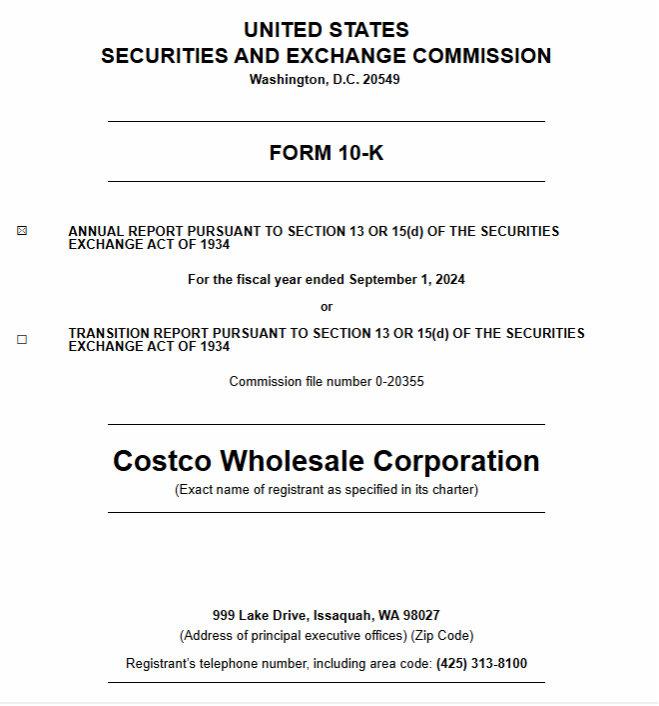
Source: Costco’s Annual Report 2024
Structure
All 10-K filings have four parts and fifteen items. The following is a brief overview of each section:
Part 1
Item 1–Business
“Business” requires the company to describe what it does, where it operates, and what subsidiaries it owns. This section may include information about the company’s competitors, recent events, and regulations.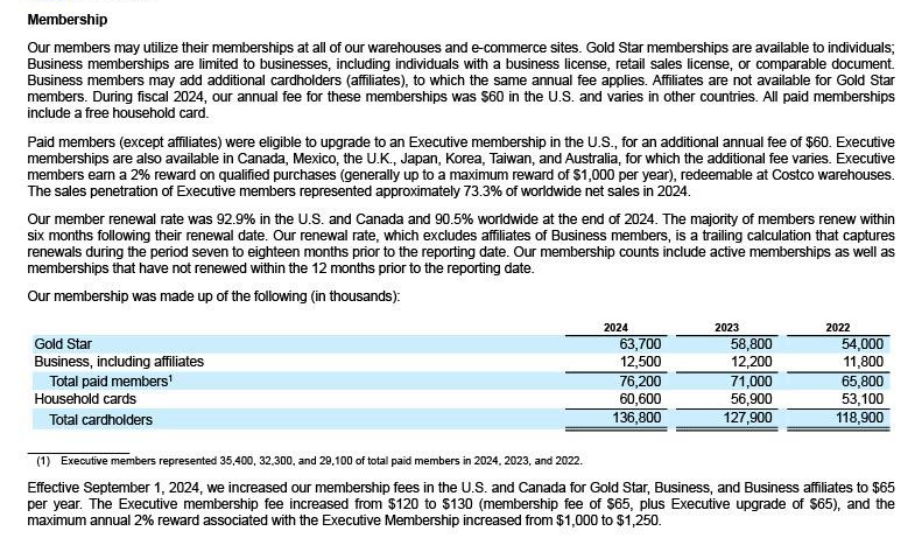 Here, Costco notes changes in its 2024 memberships.
Item 1A–Risk Factors
Describes any factors that could harm the company’s future performance. Some risks may be exclusive to the company’s industry or location like chocolate companies having their cacao plants destroyed by a virus. Other risks may apply to the entire economy, like the Coronavirus lockdowns.
Item 1B–Unresolved Staff Comments
Details any comments made by SEC staff on previous reports that are still unresolved.
Item 1C–Cybersecurity
Discusses the company’s cybersecurity risk management. The company notes any cybersecurity incidents from that year and explains what caused them and who/what they affected.
Item 2–Properties
Describes the company’s physical assets and properties such as mines or physical storefronts. Intellectual or intangible property is not included.
Item 4–Mine Safety Disclosures
Provides information on mine safety violations and regulations.
Part 2
Item 5–Market for Registrant’s Common Equity
Provides highs and lows of the company’s stock and other information on the company’s common equity. The company must disclose market information, shareholders, performance graphs, and other information related to its common equity.
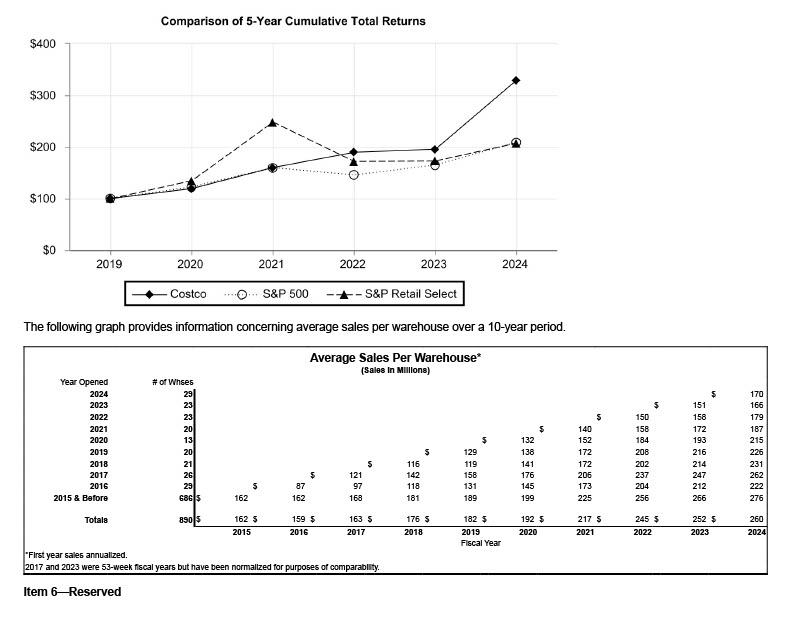 Source: Costco’s Annual Report 2024
Item 7–Management’s Discussion and Analysis of Financial Condition and Results of Operations
Provides management’s analysis of the company’s performance. Usually, company management will compare the current period to the prior period.
Item 7A–Quantitative and Qualitative Disclosures about Market Risks
Notes the company’s exposure to market risks such as interest rate, foreign currency, and commodity price risk.
Item 8–Financial Statements and Supplementary Data
Presents the following audited financial statements:
-
- Independent Auditor’s Report
- Consolidated Statements of Operation
- Consolidated Balance Sheets
- Other accounting reports and notes
The auditor’s report is crucial. It normally expresses an “unqualified opinion,” meaning the company’s financial statements are honest and accurate. If their opinion is “qualified,” then the auditor does not have confidence in the company’s financial statements.
Item 9–Changes in and Disagreements With Accountants on Accounting and Financial Disclosure
Discloses any changes or disagreements with the company’s accountants. If a company has disagreements with its accountants, that may be a red flag.
Item 9A–Controls and Procedures
Describes the company’s disclosure controls and procedures along with its internal control over financial reporting.
Item 9B–Other Information
Provides information that should have been reported in Form 8-K such as CEO departure or bankruptcy but has not yet been reported.
Part 3
Item 10–Directors, Executive Officers, and Corporate Governance
Describes company directors’ and executive officers’ backgrounds and qualifications. It also includes corporate governance practices such as a code of ethics.
Item 11–Executive Compensation
Discloses the company’s compensation programs and policies and how much compensation its executives received that year.
Item 12–Security Ownership of Certain Beneficial Owners and Management and Related Stockholder Matters
Discloses shared owned by the company’s directors, officers, and some large shareholders. It also covers shares under equity compensation plans.
Item 13–Certain Relationships and Related Transactions, and Director Independence
Details relationships and company transactions between its directors, officers, and their family members.
Item 14–Principal Accounting Fees and Services
Discloses fees the company paid to its accounting firm for different services throughout the year. This information may be listed in the proxy statement instead.
Part 4
Item 15–Exhibits, Financial Statement Schedules
Lists all financial statements and exhibits included in Form 10-K such as company bylaws, material contract copies, and a list of its subsidiaries.
