
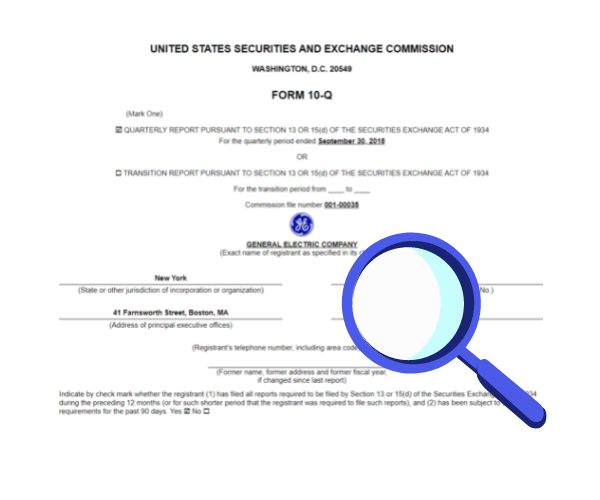
Form 10-Q, also known as the quarterly report, is one of the most important SEC Filings that every publicly-traded company in America has to submit. With each company submitting 3-4 10-Qs every year and the average filing length being about 50 pages, it can be hard to know where to start looking and what information is the most helpful to a potential investor.
The 10-Q reveals a company’s financial performance by providing a breakdown of its assets, liabilities, shareholder equity, legal proceedings, and other financial information that details whether or not the company is meeting expectations. With the Securities and Exchange Commission (SEC), an independent federal agency that regulates and protects the market, requiring each company to submit their quarterly reports within 40-45 days of the end of the financial quarter, each 10-Q reveals a company’s most recent performance upon its publishing.
With the plethora of information available in each 10-Q, it is important to know where to look to determine if the company is worthy of your possible investment. Listed below are the top 10 most important things investors should be looking for in 10-Q Filings:
1. Legal Proceedings Section
Within the Legal Proceedings section of the 10-Q, companies are required to disclose to the public any ongoing or pending legal matters involving the company that could have a significant impact on its financial condition, operations, or reputation. The SEC requires this information to be included in the quarterly report to inform investors of possible liabilities the company faces and the current status of its legal troubles. More often than not, the Legal Proceedings section of the 10-Q does not include any helpful information to the company, meaning it does not usually boost the stock’s performance. However, when the section reveals a major issue such as an SEC investigation and lawsuit, the stock price often falls dramatically, meaning it would appear as a red flag to potential investors.
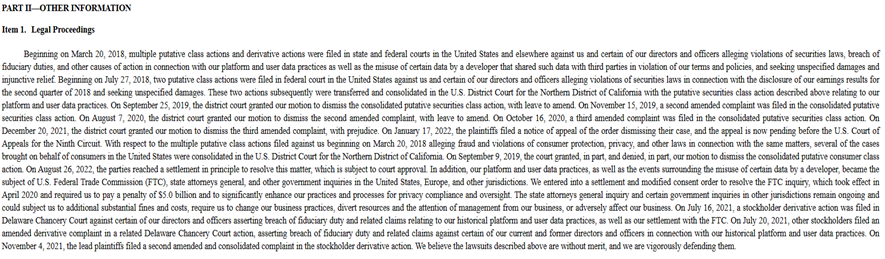
(Found in Part II – Item 1: Legal Proceedings)
The power that the Legal Proceedings Section in the 10-Q holds over stock price can be seen within Meta Platform’s 10-Q from the third quarter of 2022. Within the company’s Legal Proceedings Section, it discusses how the company has been fighting multiple class action lawsuits due to violations of securities laws, breaches of fiduciary duties, and nonobservance of its terms and policies. The section mentioned Meta’s $5 billion payment for privacy compliance and oversight as well as a $37.5 million lawsuit for location tracking. Upon the 10-Q’s release, Meta’s stock price dropped from $129.82 to $97.94 within 1 day. The negative news regarding Meta’s legal issues revealed in the Legal Proceedings Section dramatically decreased the share price and signaled to investors that Meta was facing issues.
New or significant information included in the Legal Proceedings Section of a 10-Q often causes the stock price to drop significantly which is why a potential investor needs to keep an eye out for new information to be added like a large settlement, lawsuit, or formal investigation.
2. High Earnings Per Share
Earnings per share, also known as EPS, tells potential investors how much of the company’s profit was allocated to each outstanding share of common stock. Earnings per share is calculated by subtracting preferred dividends from net income and dividing that number by the weighted average number of common shares. EPS typically is perceived as an indicator of a company’s level of profitability with a higher EPS meaning the company is more profitable and typically a better investment versus a lower EPS meaning the company is less profitable.
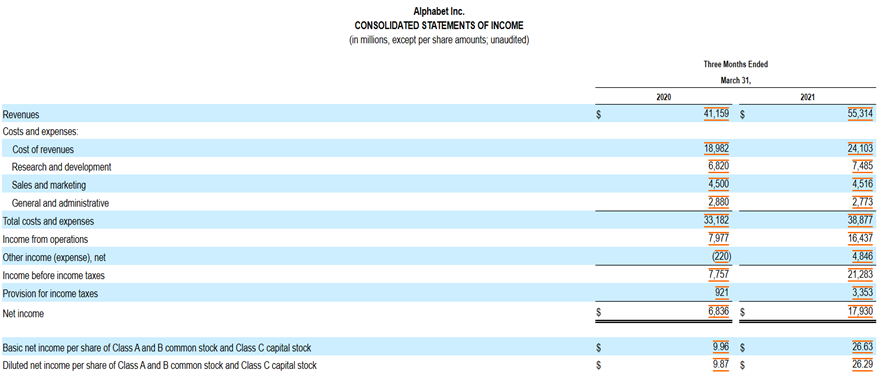
(Found in Part I – Item 1 Under “CONSOLIDATED STATEMENTS OF INCOME”)
When a 10-Q reveals a very high earning per share, it is one of the most attractive metrics that potential investors could look for. In Alphabet Inc.10-Q from the first quarter of 2021, Alphabet stated that they were able to achieve an extremely high EPS of $26.29. This was significantly higher than the first quarter in 2020 where Alphabet only achieved an EPS of $9.87. With news of the extremely high EPS, Alphabet was able to attract more investors causing the stock price to rise exponentially and achieve an all-time high price of over $2400. With a high EPS being revealed on a 10-Q, more and more investors were attracted to the stock, and the power EPS could hold over share performance was revealed.
Ultimately, high earnings per share is something potential investors should look out for because it typically indicates a healthy and growing company while attracting more investors.
3. Increasing Net Sales and Net Income
Net sales and net income are some of the most important metrics that are looked at in order to determine a company’s overall health and success. Net sales refers to the amount of sales revenue a company achieves after accounting for discounts, returns, and allowances. Oftentimes, net sales are broken down by each major good the company sells to the public and it typically indicates how good the selected company is at selling its products or services. Net income is the amount of profit that remains after removing all expenses and accounting for any non-sales-related revenue, such as investments and the sale of assets. The net income for a company typically serves as an indicator of how successful a company is in managing its costs and operations. When analyzing a company’s 10-Q as a possible investor and looking at its net sales and income, you would want to see an increase in these metrics from the previous quarter. Seeing these numbers rise would prove that the company’s growth is not stagnant and management and operations are acting efficiently and most likely will continue in the future.
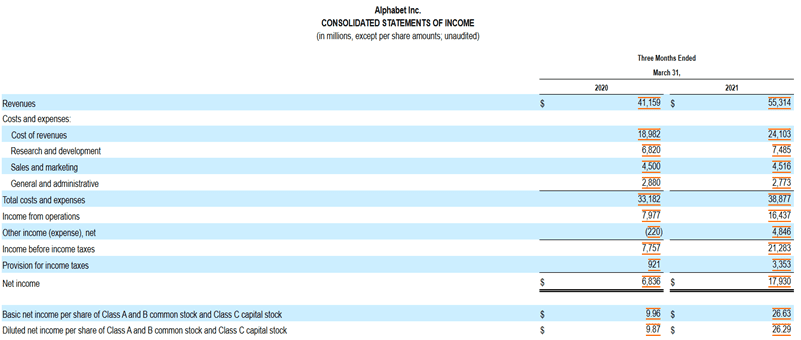
(Part I – Item 1 Under “CONSOLIDATED STATEMENTS OF OPERATIONS”)
It is very difficult for a company to achieve an increase in net sales and net income, but it is a very vital metric in analyzing the company’s direction. Within Apple Inc. 10-Q’s for the fourth quarter of 2022, the company revealed a decreasing net sales and net income when held in comparison to the first quarter report from the previous year. Regarding net sales, Apple Inc. had a drop from $123,945,000 to $117,154,000. For Apple’s net income, it dropped from $34,630,000 to $29,998,000. Both the fall in net sales and net income were considerably large and served as a bad indicator for potential investors as the decrease demonstrates Apple’s failure to maintain growth. With the news of the large fall in net sales and net income being revealed in the 10-Q, Apple’s stock price fell from $154.50 to $151.73 per share and the trading volume increased by 36.1 million. In conclusion, Apple’s falling net sales and income caused the company’s share price to drop and the public to perceive it as overvalued.
As a potential investor, it is very important to make sure the company is growing and will continue to grow. By analyzing a company’s net sales and net income and making sure that they are continuously increasing, you will be able to identify a growing company, which is important to have in a potential investment.
4. Minimal Risk Factors
Within each company’s 10-Q, is a section titled “Risk Factors” which is where the SEC requires companies to include all potential risk factors that they may face and negatively impact their operations and overall performance. Companies use this section in order to defend themselves to the public about shareholder lawsuits or large company moves and what could go wrong and discuss how it would affect the company.

(Found in Part II – Item 1A Risk Factors)
This section is broken down into 3 parts to address the risks of the company in a more detailed manner:
- Business and operations risks
- Litigation and regulatory risks
- Other risks
Although the contents of the Risk Factors section do not hold a tremendous amount of influence on stock performance, it does depict a company’s level of risk exposure, and a company with a more extensive Risk Factor section is more likely to experience negative events in the near future.
An example of a company that has just recently published a 10-Q with an extensive Risk Factor section and severe acknowledgment is Roblox, a global gaming platform. In Roblox’s most recent quarterly report for the second quarter of 2023, Roblox cited instability in the banking sector as one of its largest risks. Roblox’s mention of banking instability is due to the failure of Silicon Valley Bank which held around $150 million of its total cash and securities. Due to Federal Deposit Insurance taking control of the bank, Roblox cannot move out 100% of its holdings from within. Roblox’s Risk Factor section revealed that it is not in complete control of its financials and that its future is uncertain due to the company not knowing when it will regain complete control; therefore, if Roblox runs into financial troubles before it can remove its money from Silicon Valley Bank, then it would be put in a poor position and the company would suffer.
Ultimately, the Risk Factors section within a 10-Q does not hold a large amount of influence on a company’s share performance but is vital in determining a company’s future direction and level of risk, which is why a minimal, but detailed, Risk Factor section is ideal for a potential investor. Overall, when analyzing a 10-Q for a potential investment, it would be best to stay away from companies with a long Risk Factor section with severe acknowledgments.
5. Positive Expectations
An Expectations section is not an official section within a 10-Q, but nonetheless, many companies include their expectations for the future of the company relating to performance and sales. A company could state its expectations anywhere throughout the quarterly report, but oftentimes the majority of expectations are included in a section titled “Management’s Discussion and Analysis”. The purpose of the 10-Q is to just depict a company’s most recent financial performance and not provide forward-looking expectations, which is why when a company does include some of its expectations, it is very beneficial to a potential investor.
(Found All Throughout 10-Q)
When analyzing Walmart Inc’s second-quarter 10-Q for 2022, many expectations that could be beneficial to a possible investor were included in order to justify the company’s plans for the future. Walmart stated that it expects a continued sense of uncertainty on page 16 of its 10-Q where it said:
“We expect continued uncertainty in our business and the global economy due to pressure from inflation, supply chain disruptions, volatility in employment trends and consumer confidence, ongoing uncertainties related to the COVID-19 pandemic, including, among other matters, the effectiveness and extent of administration of vaccinations and medical treatment, any of which may impact our results.”
Walmart also stated that “material cash requirements from operating activities primarily consist[ing] of inventory purchases, employee related costs, taxes, interest and other general operating expenses, we expect to be primarily satisfied by our cash from operations” (p. 24). Furthermore, Walmary stated on page 23 that “Of the $3.5 billion at July 31, 2022, approximately $1.1 billion can only be accessed through dividends or intercompany financing arrangements subject to approval of the Flipkart minority shareholders; however, this cash is expected to be utilized by Flipkart.”Although these are just expectations and have no impact on the company’s past or future performance, they are still necessary to be looked at. These expectations inform potential investors of the plans of Walmart and show investors that it is prioritizing its new acquisition FlipKart while believing its next quarter performance will be shaky. The lack of certainty in Walmart’s expectations for the following quarter was concerning and off-putting to investors.
A company’s expectations could provide information beyond the numbers supplied in the 10-Q and let investors into the minds behind the corporation, which is why it is important for investors to look out for them.
6. Healthy Current Ratio
To see the remaining 5 points, please download our Ebook below…
